
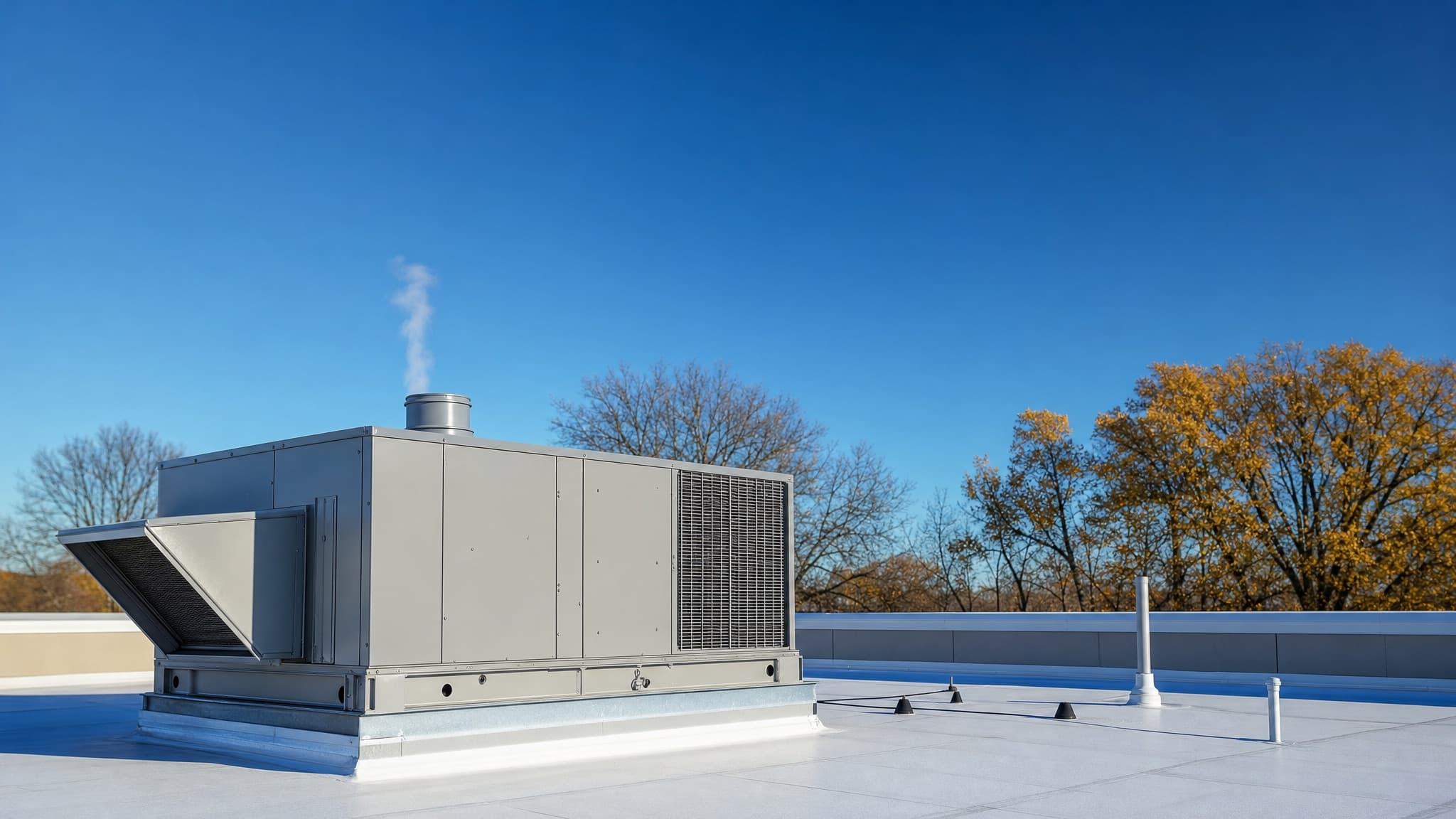
The first cold morning of the season is usually the first time in months a rooftop unit has been asked to heat. Some of them do not. The space is cold, people are keeping their coats on, and the useful question is not what is wrong with the unit. It is what you can see from inside, because that is what turns a vague call into a scheduled one.
This page is about checking and writing down. It is not a repair procedure and it is not advice about your lease.
Stay off the roof
Nothing on this page needs you on the roof. A roof on a cold morning is not a place for anybody without the equipment and the reason to be there, and the unit will not tell you anything from up close that the thermostat and a vent will not tell you from below.
If anyone smells gas, stop here. Get everyone out of the space. From a safe distance, call 911 and your gas utility, as Atmos Energy's gas leak guidance advises. Everything else on this page can wait.
Start at the thermostat
Most heat calls start and end here, so look before you call anybody.
- Is it set to heat? Not cool, not off, and not fan only.
- Is the setpoint above the room? If it is set lower than the room already is, the unit has no reason to heat.
- Is the display lit? A blank screen is worth writing down on its own.
- Is it on a schedule? If the thermostat runs a schedule, check whether it still thinks the building is closed.
- Is it showing a message? Write it down exactly, or take a photo of the screen.
Change one setting at a time and give it a few minutes before you change another. Flipping between modes makes it harder for anybody to tell later what the unit was actually doing.
Go to a vent
Stand under a supply vent and answer two questions.
- Is air moving at all?
- If it is, is it warm, room temperature, or cold?
Then walk the space. If some rooms are warm and others are cold, note which ones. If your suite is served by more than one unit, the areas that are fine matter as much as the ones that are not.
No air, air that is not warm, and only part of the space being cold are three different starting points. Saying which one you have saves a step.
Look at the breaker, once
The panel door is fine to open. The cover behind it is not.
If the panel directory shows a breaker for the rooftop unit or the thermostat and it has tripped, take a photo before you touch it. If it trips again after one reset, leave it off and say so when you call. Our post on a breaker that keeps tripping explains why another reset does not help.
The five things worth writing down
- When it last heated. Yesterday, last winter, or not at all this season.
- What the thermostat says. Mode, setpoint, room temperature, and any message, with a photo.
- What the vent is doing. Air or no air, and whether it is warm, room temperature, or cold.
- Where it is cold. Which rooms or areas, and which ones are fine.
- Anything unusual. A smell, a sound from the ceiling or the roof, and when it happened.
If you have the unit's last service record, have it nearby. If you do not, what a usable record looks like is worth reading once the heat is back on.
What that information changes
A call that opens with "the heat is out" is a visit that starts with somebody finding out what you already know. A call that opens with what the thermostat says, what the vent is doing, and where it is cold starts at the actual problem.
It also starts the file. What you write down now becomes the front half of the record, and the itemized quote and invoice become the back half.
When to stop checking
- If anyone smells gas, leave, and from a safe distance call 911 and your gas utility.
- If you smell burning or see smoke from a vent, turn the system off at the thermostat and make the call.
- If the breaker trips a second time, leave it off.
When you are ready to call
See commercial HVAC service for what we handle and to get it looked at and quoted. Bring the list.
To get ahead of it next season, a pre-winter heating tune-up checks the heat on a mild day instead.
For the wider set of operating questions a triple-net lease hands you, read the triple-net tenant guide.
Part of the freeze-ready checklist
Heat is one of three things worth settling before the first hard freeze. The other two are water and power. The full list is in the DFW freeze-ready checklist.
Your lease is the final word on what it requires and who arranges it. This page describes the usual pattern and does not interpret your document.
Any work beyond the original quote gets approved by you, in writing, before we start.