
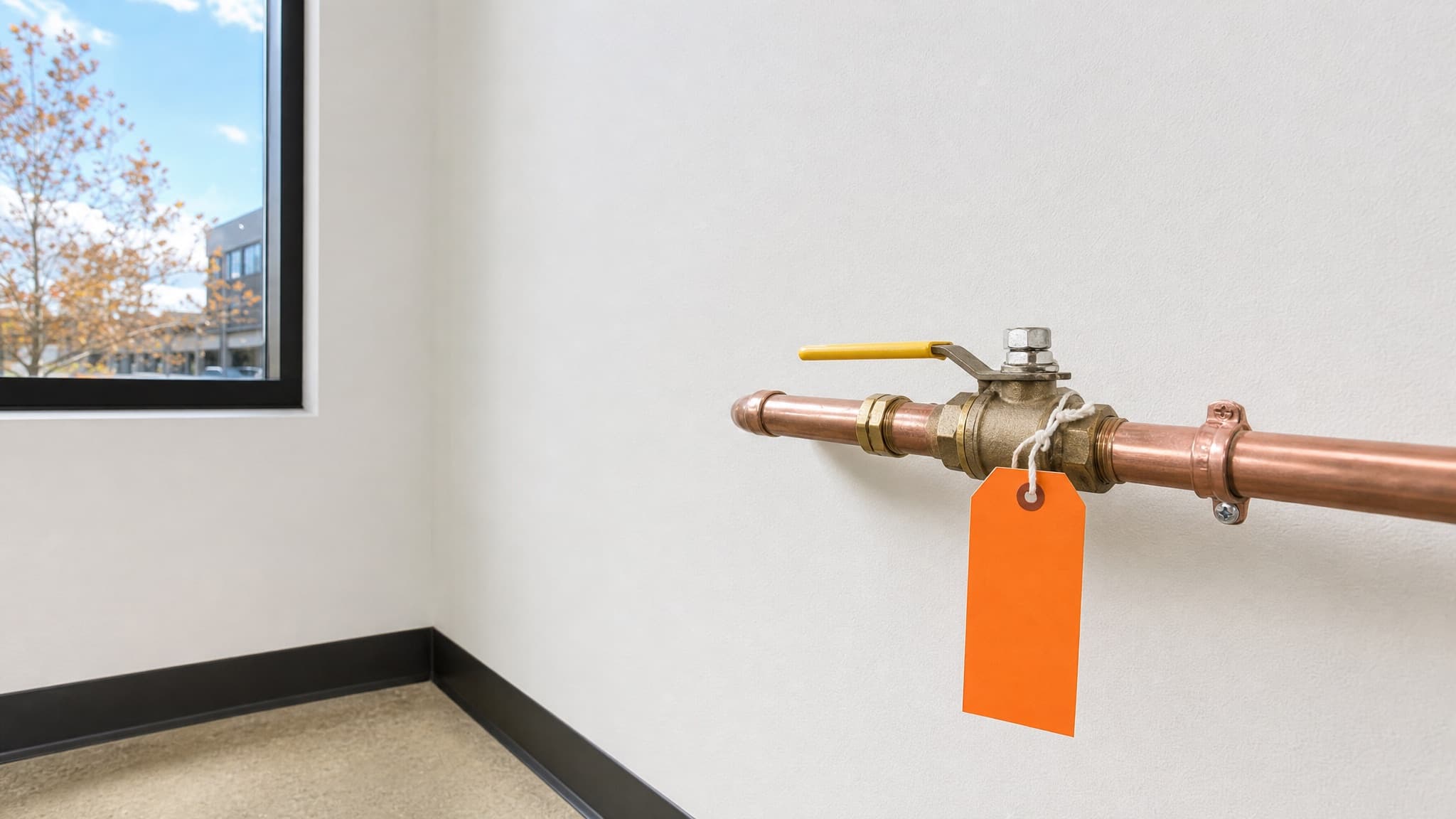
The first hard freeze of the season is a bad time to learn that nobody in the office knows where the water shuts off. If a pipe lets go, the person standing in the water needs one answer fast: where is the valve. That answer is easy to find on a quiet afternoon and hard to find with water on the floor.
This page is about finding, labeling and writing down. It is not a repair procedure and it is not advice about your lease.
Why the freeze matters
The American Red Cross puts the problem plainly in its frozen pipe guidance. Water expands as it freezes, and that expansion can break a metal or plastic pipe. The pipes it names as most at risk are the ones in unheated areas, such as attics, garages and cabinets, and the ones that run along exterior walls with little or no insulation.
You do not need to know where every pipe in the building runs. You need to know where the water to your space stops.
Where to look
Every building is plumbed differently, so treat this as a list of places to check, not a map.
- Where the water line comes into your space. A back room, a utility closet, a restroom wall, or the area around the water heater.
- At the water heater. Look at the pipe that feeds it.
- Under sinks and behind toilets. These small valves stop one fixture, not the whole space. They are worth knowing, but they will not stop a pipe that lets go inside a wall.
- Above the ceiling grid. In some suites the valve is up there. If yours is, note which tile, and remember that reaching it takes a ladder.
If you cannot find it, ask your property manager where the shutoff for your suite is. Ask too whether your suite depends on a building valve you cannot reach, and who to call for that one.
Label it
- Tag the valve. Say what it controls: the whole suite, or one fixture.
- Mark which way is off. Do it while you are calm, not while you are standing in water.
- Clear the path. If boxes or shelving block it, move them.
- Tell people where it is. Put the location somewhere everyone will see it, such as next to the breaker panel, at the front desk, or on the office contact list.
Check that it moves
If the valve is easy to reach, check that the handle moves, then put it back where it was. Do not force a valve that will not turn. Write it down instead and get it looked at before the cold arrives, because a valve that will not close is no help on the day you need it.
The five things worth writing down
- Where the valve is. In words somebody new could follow.
- What it controls. The whole suite, or one fixture.
- Whether it moved. And the day you checked.
- The building valve. If your suite depends on one, where it is and who answers for it.
- Who can close it. The people in your business who know and are allowed to.
If the faucet only trickles
The Red Cross says that if you turn on a faucet and only a trickle comes out, suspect a frozen pipe. If that happens on a cold morning, write down which faucet and when you noticed, and make the call rather than guessing which pipe it is.
If water is already moving
- Close the shutoff you labeled.
- Keep people, and anything that plugs in, away from the water.
- Take photos before you move anything.
- Make the call.
When you are ready to call
See commercial plumbing service for what we handle, including main and fixture shutoffs and leak containment when something is spraying. Bring the list.
For the wider set of operating questions a triple-net lease hands you, read the triple-net tenant guide.
Your lease is the final word on what it requires and who arranges it. This page describes the usual pattern and does not interpret your document.
Any work beyond the original quote gets approved by you, in writing, before we start.