
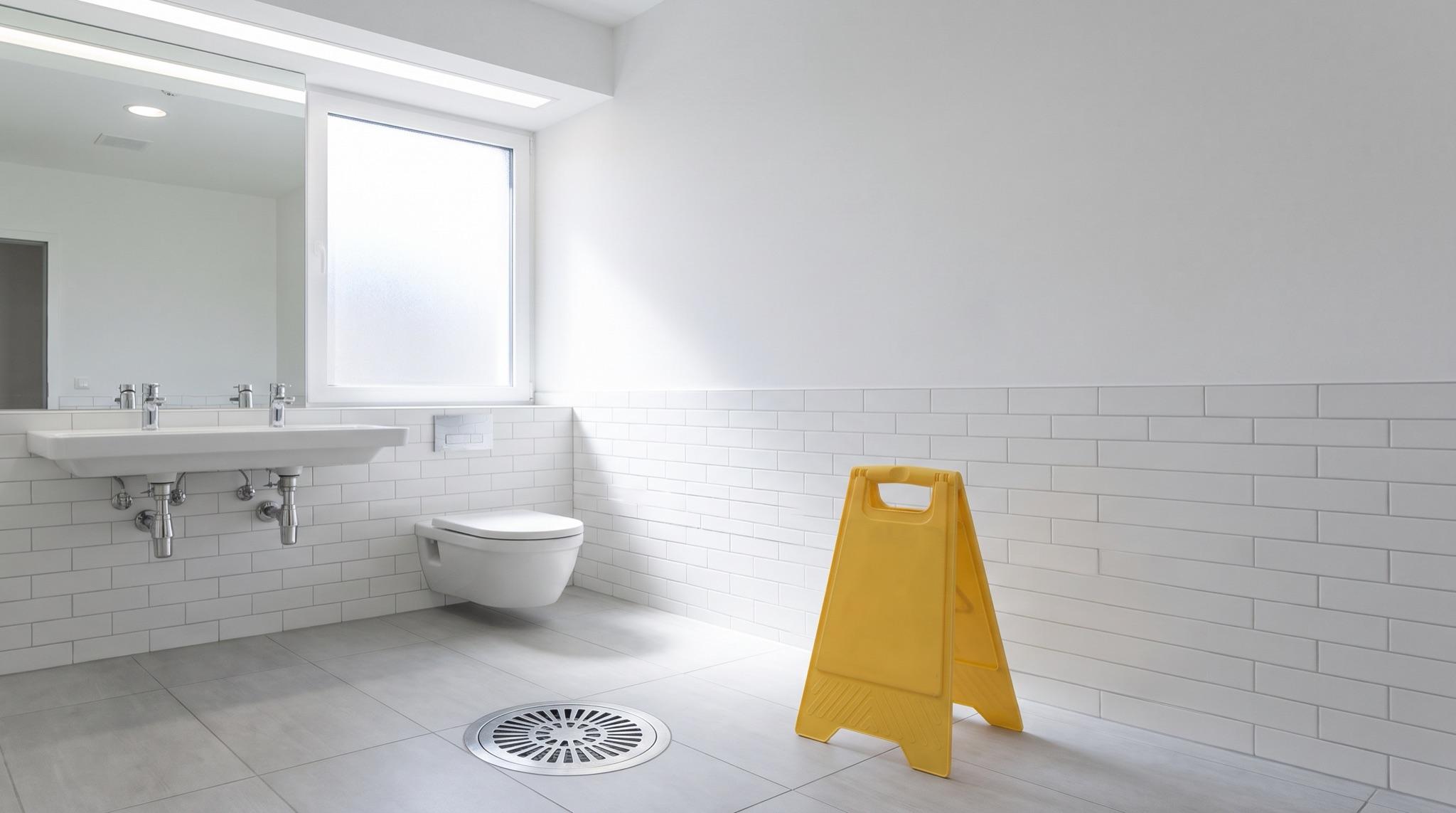
The toilet in the back restroom will not go down. Or the floor drain in the warehouse has water sitting over it that was not there yesterday. Either way something is backing up, and the useful question is not what is stuck in the pipe. It is what you can stop, see and describe from where you are standing, because that is what turns a vague call into a scheduled one.
This page is about stopping, noting and writing down. It is not a repair procedure and it is not advice about your lease.
If sewage is on the floor, keep people out of it
Close the restroom or block off the area, and keep people, and anything that plugs in, away from the water. If anyone has to step in to move something, the CDC's cleanup safety guidance says to wear rubber boots, rubber gloves and goggles when sewage is involved. Everything else on this page can wait until the area is closed off.
Stop using it
- Stop flushing the toilet that is backing up. Do not flush again to see whether it clears.
- Stop running water into the drain that is backing up. That includes the sinks in the same restroom.
- Tell everyone in the space. A sign on the restroom door does more than an email nobody reads before lunch.
Start with the symptom
Before anybody looks at a pipe, pin down what people are actually seeing.
- Which drain. A toilet, a sink, a floor drain, or a mop sink.
- One drain or several. If more than one drain is slow or backing up at the same time, say so. That is a different call from one slow sink.
- What it does. Water rising when something else is used, gurgling, a sewer smell, or water that drains slowly and then clears.
- Since when. This morning, over the weekend, or slowly over the last few weeks.
What usually goes down that should not
In a commercial restroom, the usual suspects are things people treat as paper. Defend Your Drains North Texas, a regional education campaign supported by a partnership of the North Central Texas Council of Governments, cities and water utilities, says that wipes, even ones labeled flushable, can clog a sewer line because they do not break down quickly. It says the same about paper towels, which are made to stay strong when wet. It says sewers are designed to take water, toilet paper and human waste only.
If you have a break room, the same campaign asks that fats, oils and grease go in the trash rather than down the sink.
You do not need to find out who flushed what. It is worth asking around the office before you call, because it helps whoever comes out.
What not to do
- Do not pour anything into the drain to clear it.
- Do not try to snake it yourself.
- Do not open any cleanout cap or access cover.
- Do not keep flushing or running water to test it.
None of those makes the call go faster, and some of them make the visit start with a second problem.
Tell your property manager
If several drains are backing up, or a neighboring suite has the same problem, tell your property manager as well. The line you share with the building may be the one that is blocked.
Some cities check their own part of the sewer line too. The City of Farmers Branch asks residents with a clogged sewer line to call its Public Works Department before a private plumber, so a City crew can check whether the blockage is in the City-owned part of the pipe. Your property manager will know how your building handles that.
The five things worth writing down
- Which drain. And whether any other drain in the space is slow too.
- What it does. Rising water, gurgling, a smell, or slow draining.
- When it started. And anything that happened around then, such as a busy day or other work in the space.
- Water on the floor. Where it is, and whether it is still spreading, with a photo.
- What you have already tried. Plunging, a product poured in, or nothing at all.
When you are ready to call
See commercial plumbing service for what we handle, including clogged drains, backed-up toilets and slow-draining floor drains. Bring the list and the photos.
Who is responsible for a drain line is a question for your lease. For the wider set of operating questions a triple-net lease hands you, read the triple-net tenant guide.
Your lease is the final word on what it requires and who arranges it. This page describes the usual pattern and does not interpret your document.
Any work beyond the original quote gets approved by you, in writing, before we start.